
 EN
EN
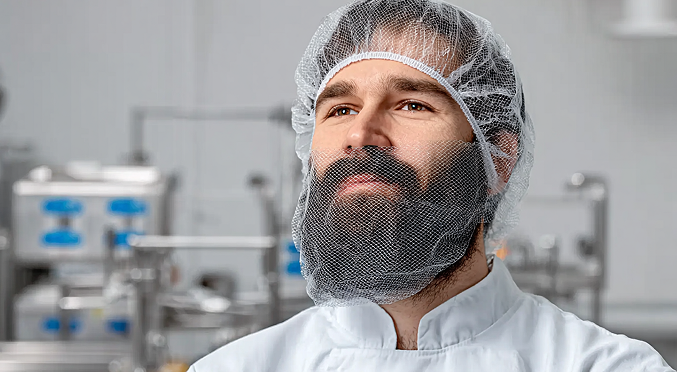
The Critical Importance of Beard Cover Sealing in Food Safety
Contamination risks of unsealed facial hair in ready-to-eat food environments
Facial hair that isn't properly contained presents serious contamination problems in food processing plants, particularly for ready-to-eat items that need complete separation from human contact during production. Just one strand of hair might carry dangerous bacteria like Staph aureus or E. coli, which explains why the CDC reports around 48 million food poisoning incidents each year across the United States according to their latest figures from 2023. And when those beard coverings don't seal correctly, several common issues tend to pop up in practice, including...
- Microorganisms detach from beard shafts directly into production zones
- Airflow disperses hair fragments onto exposed RTE surfaces
- Moisture from exhalation degrades material integrity and loosens fit
These breaches create direct pathways for biological contamination. FDA recall data consistently identifies hair as a top physical contaminant in packaged RTE foods—underscoring that seal integrity is not merely procedural but foundational to food safety.
FDA Food Code §2-301.12 and compliance requirements for facial hair restraints
The FDA Food Code §2-301.12 requires food handlers to restrain all facial hair using “hair covers, beard covers, and clothing that covers body hair.” Compliance hinges on three non-negotiable criteria:
- Complete containment: No visible hair below the jawline, including sideburns and neck hair
- Secure sealing: Zero gaps at the neckline, cheekbones, or under the chin—even during movement
- Material compliance: Non-absorbent, food-grade fabrics that resist moisture and particulate shedding
Regulatory scrutiny intensifies during SQF audits, which explicitly assess seal integrity during high-risk tasks like glove changes. Internal data from a leading food safety equipment manufacturer found facilities using improperly sealed beard covers experienced triple the microbial swab test failures compared to those with verified fit protocols (2024).
Achieving a Proper Fit: Key Factors for Effective Beard Cover Sealing
Step-by-step guide to adjusting beard covers for full containment and gap-free sealing
Start by placing the beard cover so it sits properly over the facial hair, making sure the bridge part lines up with the nose bone area. The elastic loops behind the ears need to be secured but shouldn't be stretched too much. They should stay in place without causing any pain or distorting the shape. Get the bottom part tucked under the jaw rather than just the chin area, then run fingers up along the neck to smooth out any creases or trapped air between the fabric and skin. Do a quick test by moving the head from side to side, giving a few nods, and talking out loud. If the cover lifts at all, leaves gaps, or lets hair show through, then it's not fitted correctly. For places regulated by the FDA, they have to prove absolutely no hair comes loose during these movements. Particles escaping into ready-to-eat areas can actually lead to problems with regulations, which nobody wants.
Evaluating material stretch, earloop tension, and rear neckline sealing techniques
Material performance dictates long-term sealing reliability. Key engineering benchmarks include:
| Factor | Ideal Performance | Risk of Non-Compliance |
|---|---|---|
| Material Stretch | 30–40% rebound elasticity | Gaps form with beard movement or jaw articulation |
| Earloop Tension | 150–200g consistent force | Progressive loosening over 8-hour shifts compromises seal |
| Neckline Seal | Full contact from jawbone to clavicle | Exposed neck skin flakes contaminate product—flagged in SQF Module 11.7.3 audits |
Fabrics blended with elastane generally hold up better than straight polypropylene when it comes to staying tight, particularly important for folks with thick beards over two inches long. At the back of the neck area, manufacturers have started using curved designs combined with silicone gripping strips to stop the material from rolling up when someone bends over. This is actually a common problem spotted in almost 7 out of 10 FDA inspections according to last year's Food Safety Journal report. Most quality assurance departments still rely on UV tracer tests to check if their materials meet OSHA requirements for how much particulate matter gets released. While there are newer methods being developed, this traditional approach continues to be what most facilities trust for their compliance checks.
Common Usage Mistakes That Break the Beard Cover Seal
Beard length management, neck exposure, and improper under-chin tucking
Three recurring errors consistently undermine beard cover efficacy:
- Excessive beard length: Hair longer than ¼ inch escapes containment, creating micro-gaps where loose hairs protrude
- High placement: Covers positioned above the jawline expose the posterior neck—allowing skin flakes and hair to fall onto production lines
- Incorrect tucking: Securing straps under the chin rather than below the jawbone creates slack that loosens with movement and breath
These misapplications introduce biological contaminants directly into RTE zones and accounted for 22% of FDA-reported hygiene violations in 2022. Best practice mandates weekly beard trimming flush to the skin and anchoring the cover’s lower edge firmly beneath the jawbone—not the chin—to preserve sterile barrier continuity.
Why one-size-fits-all beard covers may fail FDA and SQF compliance
The problem with standard beard covers is they don't account for how different people's faces actually look, which creates compliance issues in about 3 out of 10 food facilities during audits. Workers who have thicker beards need covers with bigger fabric pockets to properly contain everything. For folks with longer or narrower facial shapes, the elastic bands should be tighter too, maybe around 15 to 20 percent stronger than what comes standard on most products. Regular off-the-shelf designs just can't handle both keeping the neck covered and stopping the cover from slipping down under the chin at the same time, something that runs afoul of FDA Food Code section 2-301.12 as well as SQF Module 11.7.3 standards for containment. Smart food service operations know they need to keep adjustable or multiple size options available and make sure staff undergo proper fitting tests, including checking how well the covers stay put when moving around during actual work tasks.